
Let’s cut through the noise: the SEO strategy you were using in 2024 is officially a relic. If you’re still obsessing over keyword density and backlink counts like it’s a middle school science project, you’re already invisible.
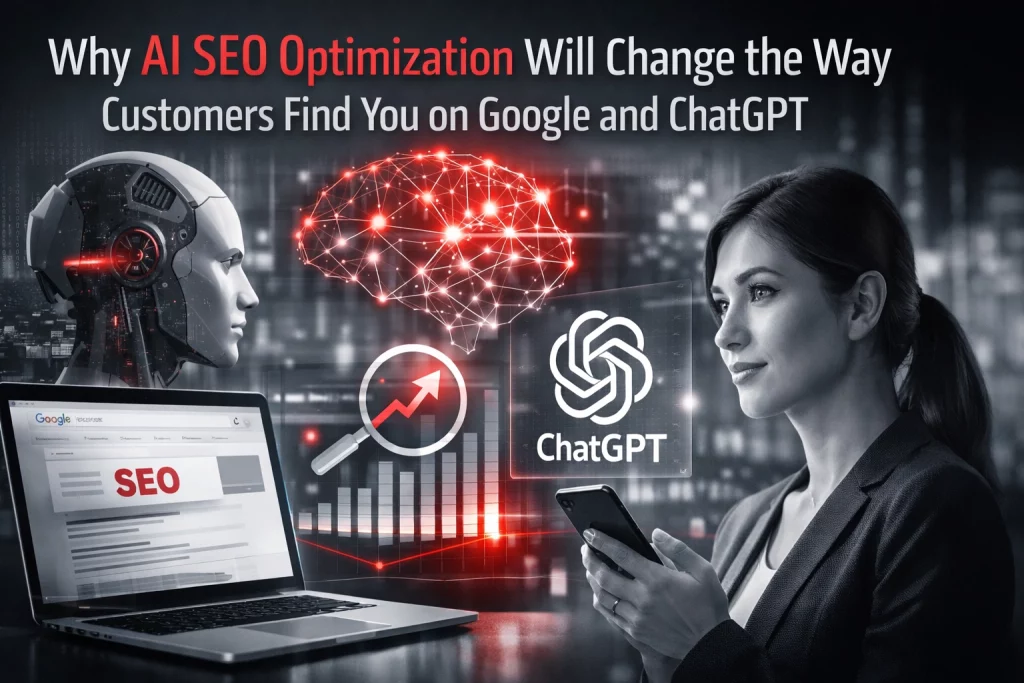
The game has changed. We aren’t just optimizing for a search engine anymore; we’re optimizing for an ecosystem of artificial intelligence. Your customers aren't just typing "plumber near me" into a search bar; they’re asking ChatGPT, "Who’s the most reliable plumber in Austin that can fix a tankless heater today?"
If your business doesn't show up in that AI-generated answer, you don't exist.
I’ve watched small businesses dump thousands into "traditional" SEO agencies only to see their rankings stay flat while a leaner, meaner competitor leaps over them using ai seo optimization. It’s not magic. It’s just faster, smarter, and, frankly, what you should have been doing months ago.
The Death of the Keyword (As You Know It)
For a decade, SEO was about matching phrases. You wanted to rank for "local seo services," so you slapped that phrase in your H1, your meta description, and three times in the first paragraph.
Google’s AI, and certainly LLMs like ChatGPT or Claude, are way past that. They prioritize understanding user intent. They don’t care if you have the exact keyword; they care if you have the actual answer.
Algorithms now analyze how users phrase questions, what problems they’re trying to solve, and which content formats actually provide relief. This shift means that "ranking" is no longer about winning a popularity contest; it’s about winning the "helpfulness" contest.

What nobody tells you about AI Search
Here is the uncomfortable truth: Google is becoming an "answer engine," not a "search engine." With Search Generative Experience (SGE), Google provides a summary at the top of the page that answers the user’s question without them ever needing to click your link.
Wait, isn't that bad for traffic?
If you’re writing generic garbage, yes. It’s a death sentence. But if your ai seo optimization is dialed in, your brand becomes the source for that AI answer. You’re not just a link in a list; you’re the expert the AI is quoting. That’s how small companies look big and start stealing market share from the giants.
The ChatGPT Factor: Why Being "Findable" Isn't Enough
People are increasingly bypassing Google altogether for complex queries. They’re using ChatGPT or Perplexity to research products and services.
When someone asks an AI for a recommendation, that AI looks for trust and authority signals. It looks for reviews, brand mentions, and consistent, high-quality content that demonstrates you know what you're talking about.
I’ve seen businesses with beautiful websites fail simply because they lacked the "digital breadcrumbs" that AI needs to recommend them. You need to be mentioned in the right places, and your content needs to be structured in a way that LLMs can digest.
If you’re still running a site built on a template from 2018 with no updates, you’re essentially whispering in a room full of people screaming. You need small business website design that isn't just "pretty": it needs to be architected for data consumption.
The "Honest Investment" Breakdown: AI SEO vs. Traditional SEO
Let’s talk numbers. I’m not here to blow smoke. AI SEO isn't "free" just because tools exist.
| Feature | Traditional SEO | AI-Enhanced SEO |
|---|---|---|
| Research Time | 10–20 hours (Manual) | 1–2 hours (AI-Clustered) |
| Content Quality | Hit or Miss | High (when human-edited) |
| Adaptability | Slow (Months) | Fast (Weeks) |
| Cost (Agency) | $2k–$5k/mo | $1.5k–$4k/mo (PowerFast Model) |
| Technical Depth | Basic | Advanced (Schema & LLM-ready) |
The real cost of AI SEO isn't the software; it's the strategy. Anyone can buy a subscription to an AI tool. Not everyone knows how to prompt it to create content that doesn't sound like a robot wrote it while drunk on marketing jargon.
At PowerFast Digital, we use these tools to handle the heavy lifting of keyword clustering and technical audits so we can spend our time on what actually matters: conversion-focused strategy.

Technical Reality Check: Speed Kills (Your Rankings)
You can have the best AI-optimized content in the world, but if your site takes four seconds to load, Google’s AI will bury you.
Google’s Core Web Vitals are a direct ranking factor. Why? Because AI-driven search engines prioritize user experience. If your site is slow, it’s a bad experience. Period.
This is where fast website hosting and consistent website maintenance come into play. Most small business owners treat their website like a slow-cooker: set it and forget it. But a website is more like a high-performance vehicle. If you don't change the oil and tune the engine, it’s going to break down right when you need it to perform.
The Reality: If your "SEO expert" isn't talking about your server response time or LCP (Largest Contentful Paint), they aren't an expert. They’re a copywriter with a fancy title.
How to Win in 2026: A 3-Step Roadmap
If you want to stop being a ghost on the second page of Google, here is how you pivot:
1. Optimize for "Answers," Not "Keywords"
Stop writing 500-word blog posts about "Why you need a lawyer." Start writing 1,500-word deep dives that answer "How much does a commercial litigation lawyer cost in Chicago in 2026?" Provide structures, tables, and real data.
2. Dominate Local Signals
For small businesses, local seo services are your bread and butter. AI relies heavily on local citations and reviews to verify you’re a real human with a real office. If your Google Business Profile is a ghost town, ChatGPT isn't going to recommend you.
3. Build for the Machine, Write for the Human
Your site needs "Schema Markup": code that tells the AI exactly what your price is, who your authors are, and what services you offer. But the text itself? It needs to be witty, bold, and engaging. If a human won't read it, an AI eventually won't rank it.

Skip AI SEO if…
I’ll be honest: not everyone needs this.
- Skip it if: You have a 20-year-old referral-only business and don't want new customers.
- Skip it if: You’re okay with your competitors siphoning off 80% of the local search traffic.
- Skip it if: You think "The AI thing" is just a fad (spoiler: it’s not).
For everyone else: the ambitious ones, the ones who want to scale: this is the single most important shift in digital marketing in the last two decades.
The Bottom Line
The gap between the "haves" and the "have-nots" in the digital space is widening. Companies using AI-driven strategies are moving ten times faster than those stuck in 2020.
You can either spend the next six months wondering why your phone isn't ringing, or you can rebuild your presence to be the answer that Google and ChatGPT are looking for.
Let’s be real: you’re too busy running a business to become an AI expert. That’s why we’re here. At PowerFast Digital, we don't just build websites; we build growth engines. We take the "Sleek, Fast, Bold" approach and apply it to every line of code and every piece of content.
Ready to see how your site stacks up against the AI revolution? Contact us today and let’s stop the bleeding. It’s time to make your small business look like the industry leader it actually is.